
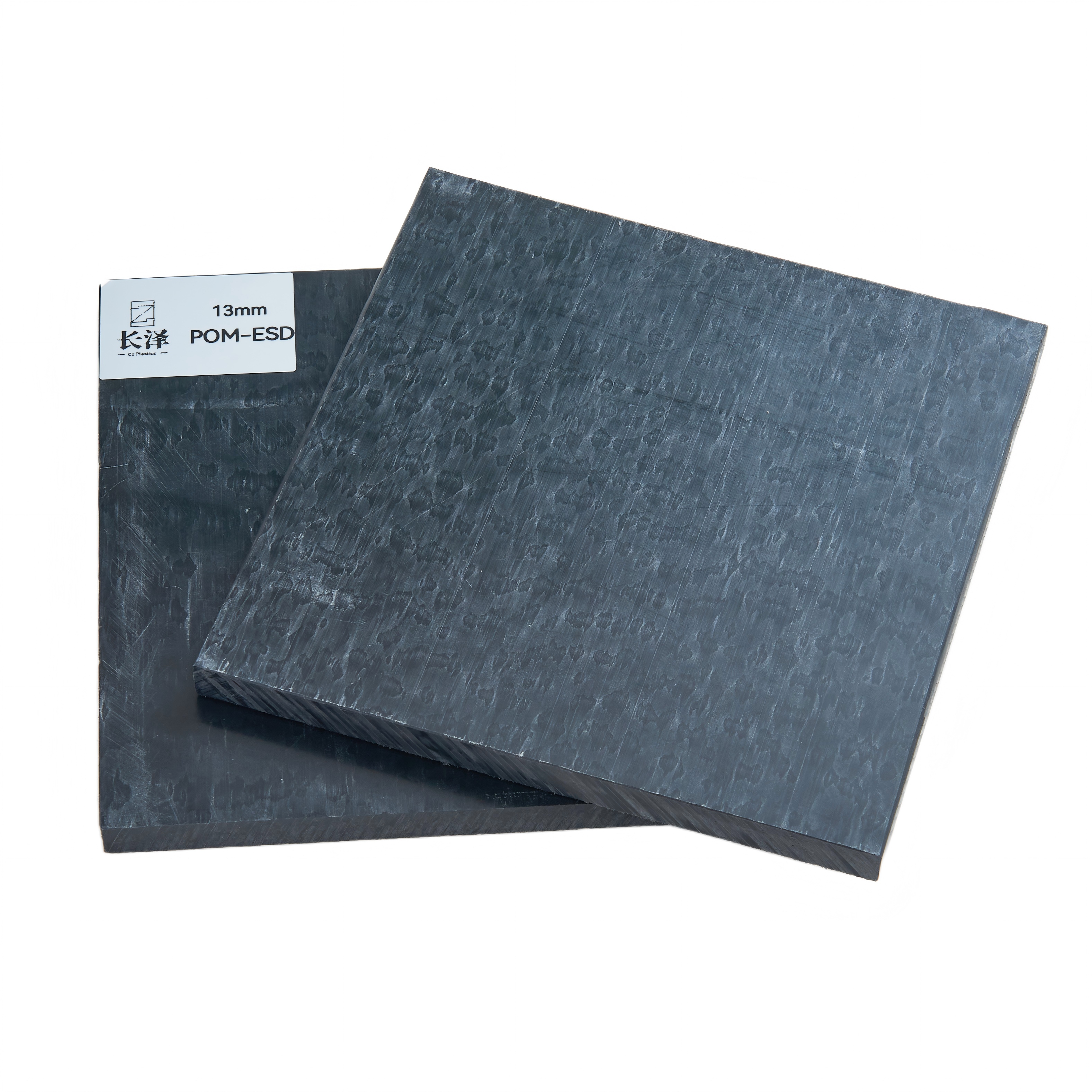
Semiconductor expansion is now limited by cleanroom space rather than tool supply. Inside the carbon-black POM-C sheet that keeps fixtures, carriers and work surfaces static-safe at 10⁴–10⁶ Ω.
The Bottleneck Moved To The Cleanroom
Applied Materials reported record fourth-quarter results on 13 November 2026 and, in the same statement, named cleanroom capacity rather than equipment supply as the binding constraint on how quickly chip production can expand. SEMI's October 300mm outlook shows the scale of what is being built behind that constraint: US$149 billion of front-end fab equipment spending in 2026, up 31 percent year on year, with 20 new 300mm fabs or lines breaking ground this year and 13 starting operations.
Cleanroom space is not empty space. It arrives as walls, floors, air handling, fixtures, carriers, jigs and work surfaces, and every one of those surfaces sits close to devices that a stray charge can damage. That is the demand the ESD POM sheet was built for.
What ESD POM Sheet Actually Is
ESD POM sheet is a copolymer polyoxymethylene compounded with carbon black to a conductive grade. The appeal is that it keeps the behaviour of ordinary POM-C — the same machining feel, the same dimensional stability after cutting, the same wear resistance — while changing the electrical picture completely. Surface resistance sits at 10⁴ to 10⁶ Ω measured to ANSI/ESD STM11.11, volume resistivity at 10² to 10⁴ Ω·cm to IEC 62631-3-1, and static decay runs under 2 seconds from 5,000 V to 50 V to FTMS 101B.
The important word there is bulk. Conductivity comes from carbon black dispersed through the material, not from a surface coating, so a machined edge, a re-cut face or a worn corner still dissipates. Parts that rely on a sprayed or dipped layer do not behave that way, and in a cleanroom the difference is discovered at the worst possible moment.
Sizes And Machining
Stock thickness runs from 5 mm to 120 mm in 640 × 1250 mm and 1000 × 2000 mm sheets, with ±0.3 mm thickness tolerance on standard sizes and length and width cut to order. The material machines like any other acetal — saw, mill, drill, tap — which matters more than it sounds, because most ESD fixtures are one-offs made to a drawing rather than catalogue parts. A sheet that behaves like the POM-C plastic plate the shop already runs needs no new feeds and speeds on the floor.
Where It Fits, And Where It Does Not
The applications are mostly unglamorous: wafer handling trays, test fixtures, cleanroom jigs, SMT line tooling, work surfaces and carrier frames. All of them need the part to be stiff, stable and non-charging at once.
The limits are worth stating plainly. Continuous service temperature is −50 to +90 °C and the heat deflection temperature at 1.8 MPa is 82 °C, so anything that sees reflow or an oven cycle belongs elsewhere — PEEK plastic plate covers the far end of that range. ESD POM is the right answer for the room-temperature fixture, not for the process chamber.
Ordering ESD POM Sheet
Send the thickness, sheet size, quantity and, where relevant, a drawing. We confirm stock, price and lead time, and cut to size where the part allows it. The current listing covers 13 mm and other standard thicknesses; the full range runs to 120 mm.