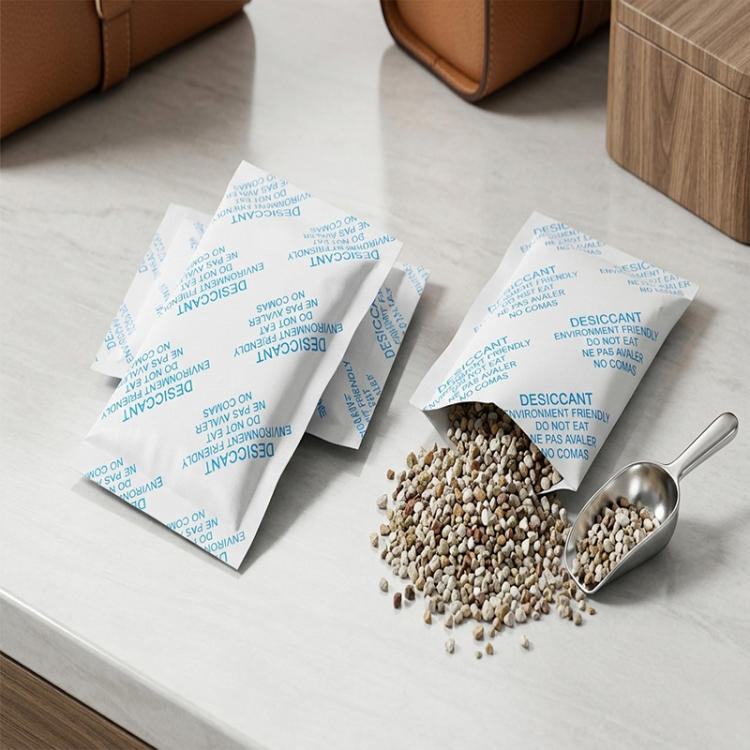
This guide quantifies the moisture load on a standard ocean voyage, gives a defensible dosage range for drying agents for shipping containers, and explains the five placement errors that make humidity control in shipping containers fail even when the quantity is right.
1. How much drying agent does a 40ft container actually need?
Plan on 0.08 kg of calcium chloride per m³ of container air as the floor, 0.15 kg/m³ for voyages over 30 days through tropical zones, and add 50% for timber, paper or textile cargo — which puts a 40ft GP at 5.4 kg minimum and 10 kg for a long, humid route.
The load comes from three sources, and the first one alone usually exceeds what buyers budget for:
- Air sealed in at loading. At 30 °C and 80% RH, container air holds about 24 g of water per m³. A 40ft GP holds 67 m³ — that is 1.6 kg of water suspended in the air before cargo is considered.
- Nightly condensation cycles. Cool that air to 20 °C and its saturation point falls to 17 g/m³, so roughly 7 g/m³ has to go somewhere: 0.47 L per night, about 14 L across a 30-day voyage, dripping from the ceiling onto cartons.
- Cargo and packaging. 200 kg of pallet timber at 18% moisture content carries about 30 kg of water; even a tenth of it migrating into the air adds 3 L. Add cardboard, jute, cotton or green wood and the figure climbs fast.
|
Container |
Air volume |
Moderate route (0.08 kg/m³) |
Long or tropical route (0.15 kg/m³) |
Hygroscopic cargo (wood, paper, textile) |
|
20ft GP |
33 m³ |
2.6 kg |
5.0 kg |
+50% |
|
40ft GP |
67 m³ |
5.4 kg |
10 kg |
+50% |
|
40ft HC |
76 m³ |
6.1 kg |
11.4 kg |
+50% |
Sanity-check the number against capacity, not against weight. Calcium chloride holds 200–300% of its own mass, so 6 kg of gel absorbs 12–18 kg of water — comfortably above the 14 L condensation figure on a normal route, and marginal once cargo moisture is added. That margin, not the invoice price, is what you are buying: for humidity control in shipping containers, the margin is the whole specification.
Silica gel and clay do not belong in this calculation at all, and no supplier should size a container with them. At 20–40% capacity, matching 6 kg of calcium chloride would take 30–60 kg of silica gel, and clay stops absorbing below 40% RH — exactly the range where container interiors spend their nights. Calcium chloride drying agents for ocean freight work because deliquescence keeps pulling vapour at 80–95% RH, long after a physical adsorbent has reached equilibrium. In-carton moisture absorbers answer a different question entirely.
✅ Bottom line: Dosage is a capacity decision, not a weight decision — 0.08 kg/m³ is the floor for calcium chloride, and long tropical routes need roughly double.
2. Why does humidity control still fail when the quantity is right?
Because placement, sealing and timing decide whether the gel ever meets the moisture: desiccant sitting on the container floor, or loaded two days before the doors close, absorbs a fraction of its rated capacity no matter how much you paid for it.
Five failure modes account for most moisture claims:
- Placed on the floor. Condensation forms on the ceiling and upper walls because those surfaces cool first. Hang blanket or pole units 10–20 cm below the roof, clipped to lashing rings, spaced every 5–6 m along the box.
- Loaded too early. A unit that hangs in an open, ventilated container during loading absorbs ambient port air before the doors shut. Put drying agents for shipping containers in last, immediately before sealing.
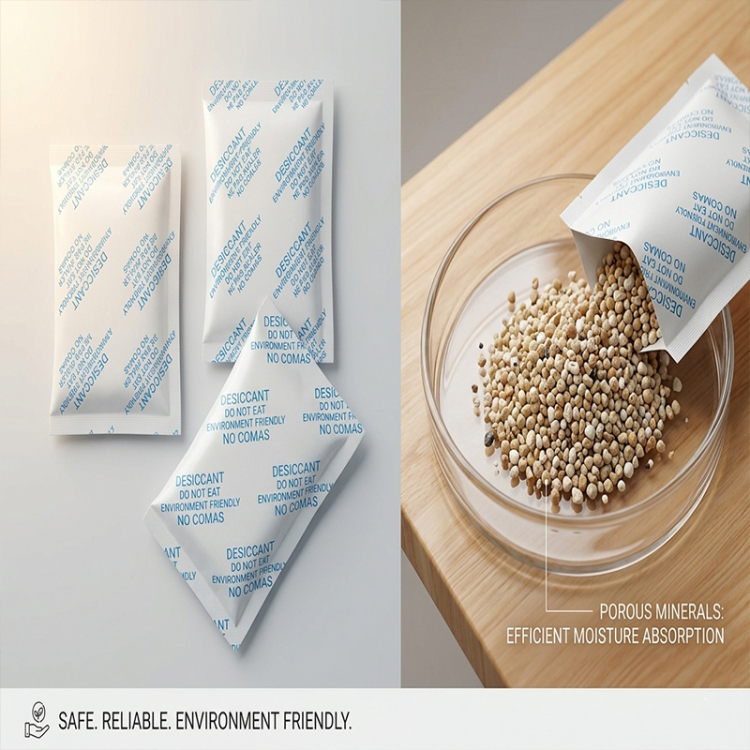
- Confusing in-carton sachets with container protection. Desiccant packets control the 2 litres of air inside a retail box; they cannot touch 67 m³. Use them inside the carton for the product and container-scale units for the box — different problems, not substitutes.
- Cargo wrapped in shrink film. A pallet sealed in stretch wrap keeps the desiccant away from the cargo surface, so condensation forms on the film and runs into the carton edges. Vent the wrap or use perforated film.
- Wet gel leaking back. Cheap single-layer bags release brine once saturated. Two-layer film with a gel lock keeps the liquid inside, which is why the double-layer construction used by KANGRIS for its 100 g and container-format calcium chloride units matters more on a 45-day route than on a 10-day one.
One more check that costs nothing: confirm door gaskets and vent seals before loading. Ingress through a worn gasket can add several litres over a long voyage, and no amount of desiccant packets compensates for a box that breathes. On 30-day routes, calcium chloride drying agents for ocean freight are also the only category that keeps capacity through 30 condensation cycles — everything else is a supplement.
✅ Bottom line: Hang it high, load it last, and never ask an in-carton sachet to dry a container — placement and timing decide whether capacity is ever used.
FAQ
Q: Can silica gel packets replace container drying agents? A: No. Drying agents for shipping containers protect the 67 m³ of air around the cargo; small moisture absorbers only protect the sealed product volume. A 40ft box would need 30–60 kg of silica gel to match 6 kg of calcium chloride, which is neither practical nor economic.
Q: How long do container drying agents last, and can they be reused? A: A well-sized KANGRIS calcium chloride unit holds 60–90 days, covering a normal Asia–Europe voyage. Once the salt has turned to gel it is spent and must be replaced — unlike reusable silica gel, it cannot be regenerated.
Q: Do you supply OEM and private-label container desiccants in wholesale quantities? A: Yes. Suzhou Cress Desiccant Co., Ltd. manufactures two-layer calcium chloride container units, hanging blankets and 100 g–1 kg packs under the KANGRIS brand, with ODM custom sizes and print, from two factories in Suzhou and Anhui running 80 automated machines and a 98.8% qualification rate.
CTA
Send KANGRIS the container type, route, transit days and cargo description, and the team will return a dosage figure in kilograms plus a placement diagram within one working day — free of charge. OEM and wholesale buyers can request two-layer calcium chloride samples and REACH/RoHS documentation in the same reply.